1. Ben Youssef Madrasa
Until it closed in 1960, Marrakesh had one of the largest madrasas in North Africa. It accommodated more than 800 students.
Builders completed this complex during the reign of Sultan Abdallah al-Ghalib (1517–1574), constructing it on the site of an earlier 14th-century madrasa built under the Marinid dynasty. The site opened to the public as a historic monument in 1982.
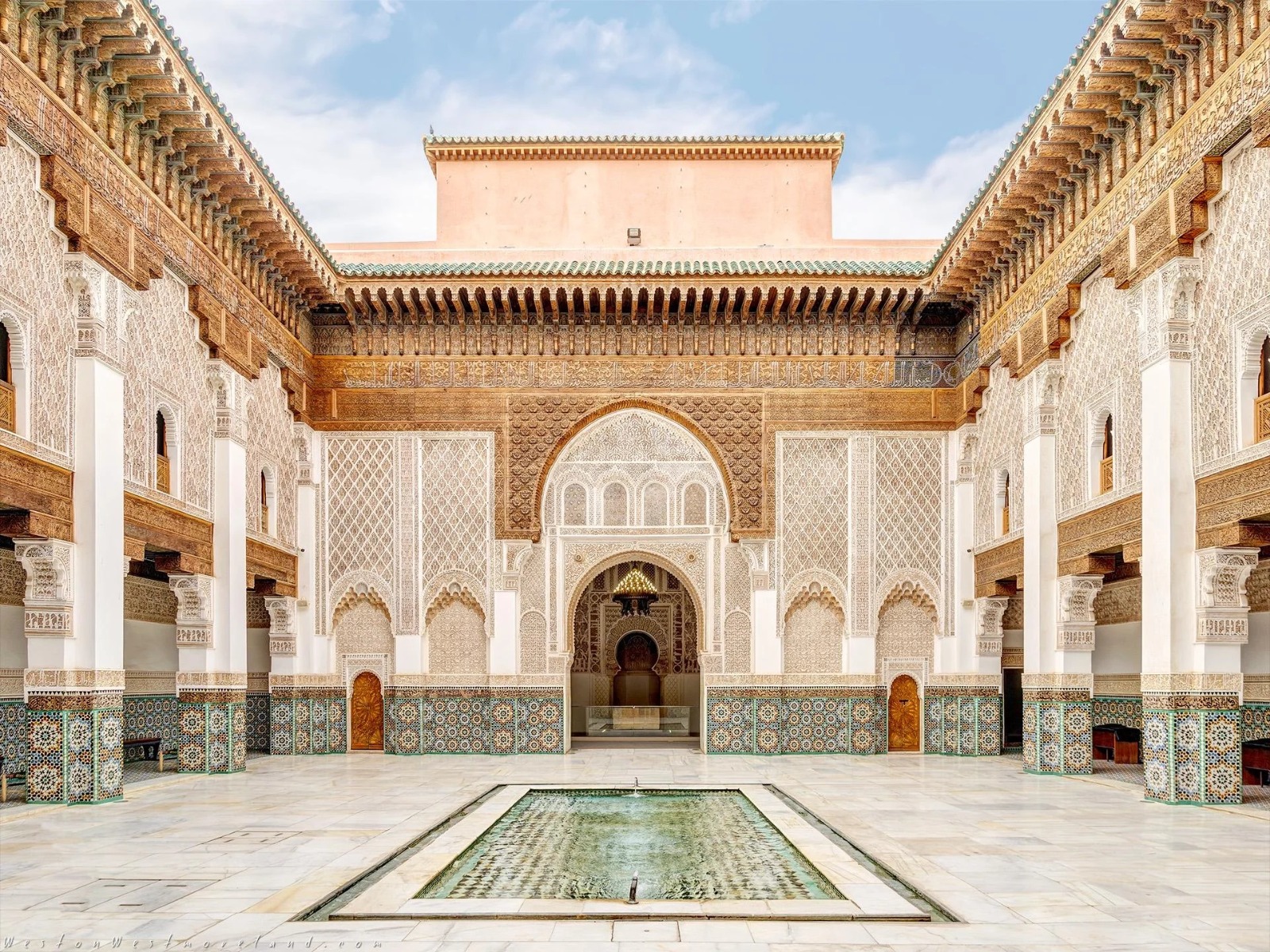
Architects centred the design on a magnificent interior courtyard, using dazzling mosaics, delicate stuccowork, finely carved cedar, and bands of Arabic calligraphy to inspire awe around a rectangular reflection pool. At the far end of the courtyard, opposite the entrance, the mihrab commands attention, richly adorned with even more vibrant tilework.
This richness continues in the latticework and moulded stucco niches of the secondary courtyards, while the student’s cells are purposely unadorned.
2. Bahia Palace
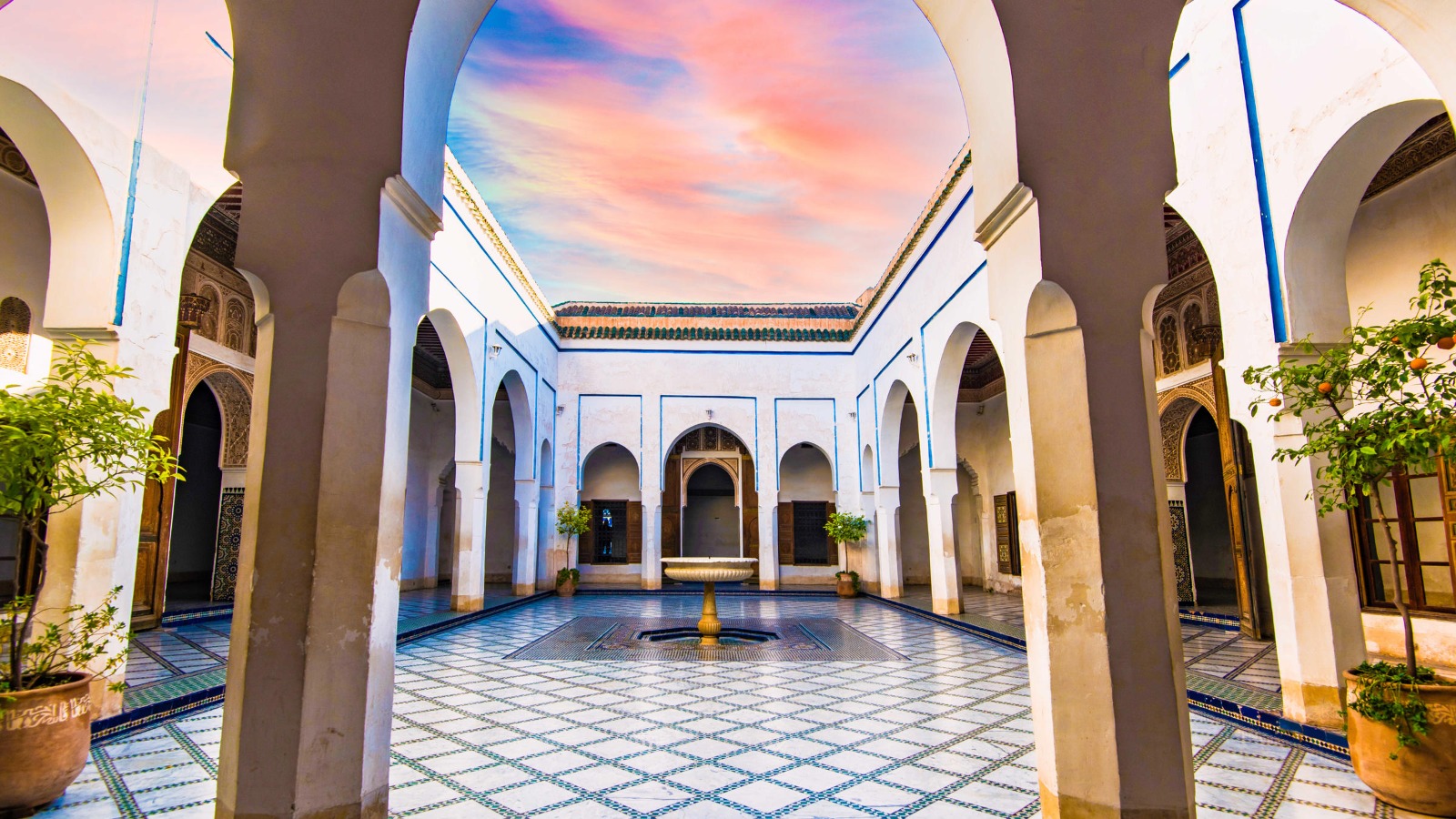
Bahia Palace reached its current scale and opulence under the grand vizier Ba Ahmed (d. 1900). The intensely decorated palace, on eight hectares in the south-east of the Median, was begun in the 1860s and then extended by the famously portly Ba Ahmed, whose additions included a gigantic harem on a courtyard around a central basin. The complex abounds with painted cedar and beech ceilings, gleaming white marble, multicoloured zellige, elaborate latticework, stained glass and gardens laden with jasmine, hibiscus, citrus trees and banana trees. The grand vizier had no fewer than four wives and 24 concubines. This explains the magnitude of this space. Ba Ahmed’s wives each had an apartment identical in size, denoting their equal status, and around the palace you will step through the school/mosque for his many sons and daughters and the hall where he conducted business.
3. Koutoubia Mosque
The 77-metre minaret of the city’s largest mosque has towered above the west side of the Medina for more than 800 years. When the French drew up the Ville Nouvelle, this Medieval tower was still the guiding landmark, and is visible for almost 30 kilometres. Completed in the reign of Almohad Caliph Yaqub al-Mansur, the minaret came before, and inspired, Seville’s famous Giralda and the Hassan Tower in Rabat, also Almohad creations. Instead of steps, the minaret has a ramp inside, so that the muezzin could ride up to give the call to prayer. This also means that the orientation of the interlaced window arches is slightly different on each facade.
4. Jemaa el-Fnaa
Marrakesh’s fevered marketplace was born as a space for military parades and executions in front of the palace that preceded the Koutoubia Mosque. Jemaa el-Fnaa is a frenzy all day and into the night. In the afternoon there will be snake charmers, Barbary monkeys, orange juice stalls and water sellers. Later these withdraw to be replaced by a mass of dancing youths dressed as women (who wouldn’t be permitted to dance), magicians, fire breathers, acrobats and storytellers. These are soundtracked by bands of gnaoua musicians in blue robes. At night there are myriad food stalls at Jemaa el-Fnaa for tagines, couscous, sizzling meat skewers and spiced soups with lentils and chickpeas.
5. Saadian Tombs
6. Jardin Majorelle
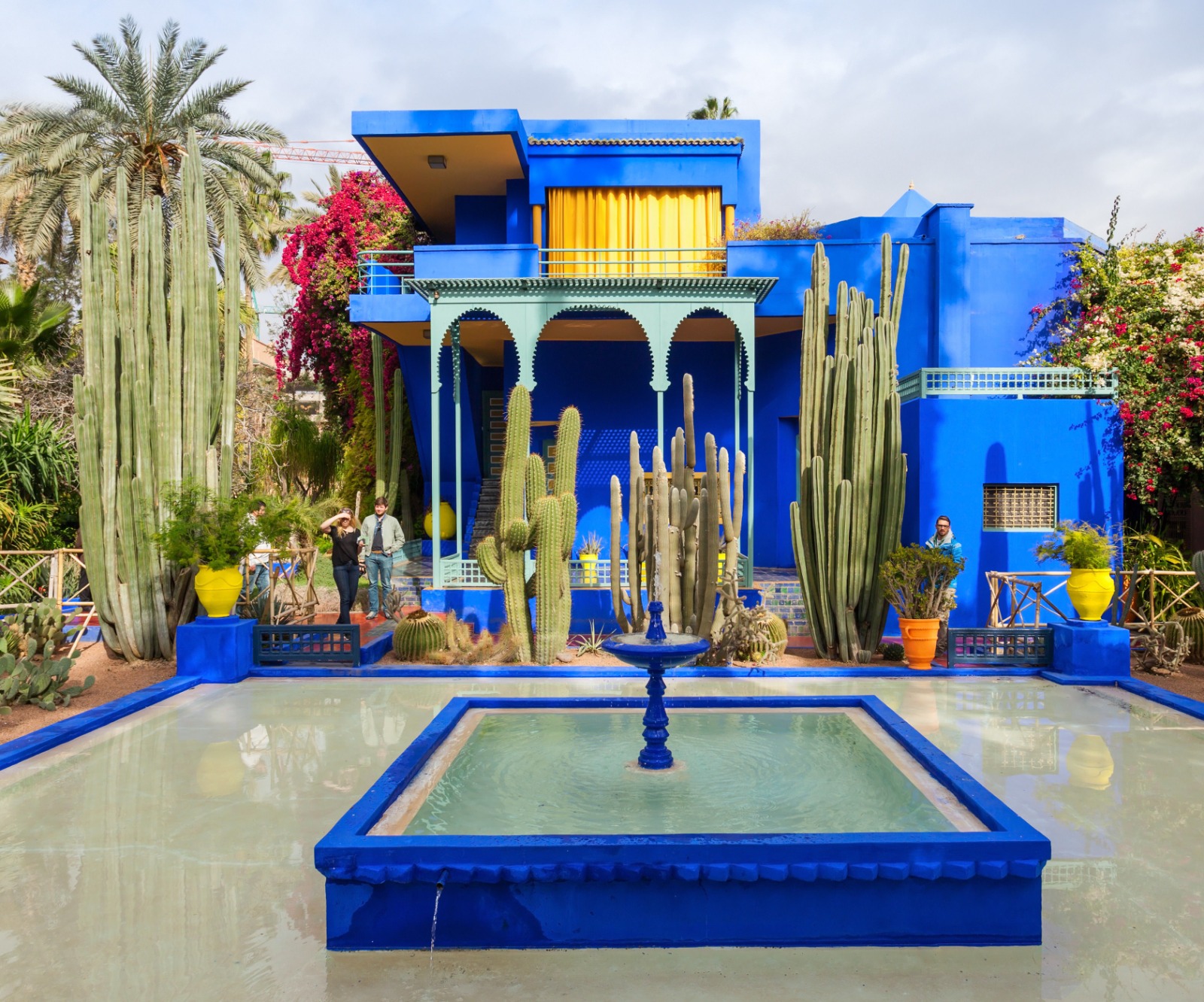
Yves Saint-Laurent bought up and restored this transformative garden and its Cubist villa in the 1980s. It was all the work of Jacques Majorelle (1886-1962), son of the fabled Art Nouveau furniture designer Louis Majorelle. Jacques spent more than forty years perfecting this 2.5-hectare space, and you can wander among the bamboo, outlandish tall cactuses and bright bougainvillea. Fronted by a square fountain in the same shade of cobalt blue, Majorelle’s villa and studio holds a museum for Islamic art, presenting Saint-Laurent’s personal collection of North African textiles, ceramics and jewellery, along with a collection of Majorelle’s paintings.
7. Museum of Marrakesh
Despite the name, the Museum of Marrakesh is concerned less with the history of the city and more with the architecture and decor. Next to the Ben Youssef Madrasa, this is a palace built at the end of the 19th century for Mahdi Menhbi, by the defence minister under Sultan Moulay Abdelaziz (1878-1943). The palace lost its sheen during a period of neglect. It was restored and turned into a museum in the 1990s. The best bit is the unusually large patio. It takes up more than 700 square metres, and is dominated by a spectacular multi-tiered chandelier. On the ground floor are small displays of hammered copper objects, Berber jewellery, weapons and clothing, while upstairs you can take a close look at the dainty Moorish decor and fine cedar furniture.
8. The Souks of Marrakesh
A fact you may hear about Marrakesh is that it’s a city of 40,000 craftsmen. On the close, intersecting alleys pulling off the immense Jemaa el-Fnaa you can see what all these artisans get up to. Effervescent, picturesque and hectic, the souks are as much an experience as a shopping opportunity. There’s a Souk Smata for babouche slippers. There is a Souk Seffarine for brassware. A Souk Haddadine for blacksmithing as well as a Souk Chouari for carved cedar and the famed Souk Cherratin, selling all manner of leather goods, from purses to belts. Souk Sebbaghine, the dyers’ souk, is a photographer’s dream. It uses strands of wool in bright colours drying overhead. You will be expected to haggle, but through this act it’s worth bearing in mind that all traders want to make a sale.
9. El Badi Palace
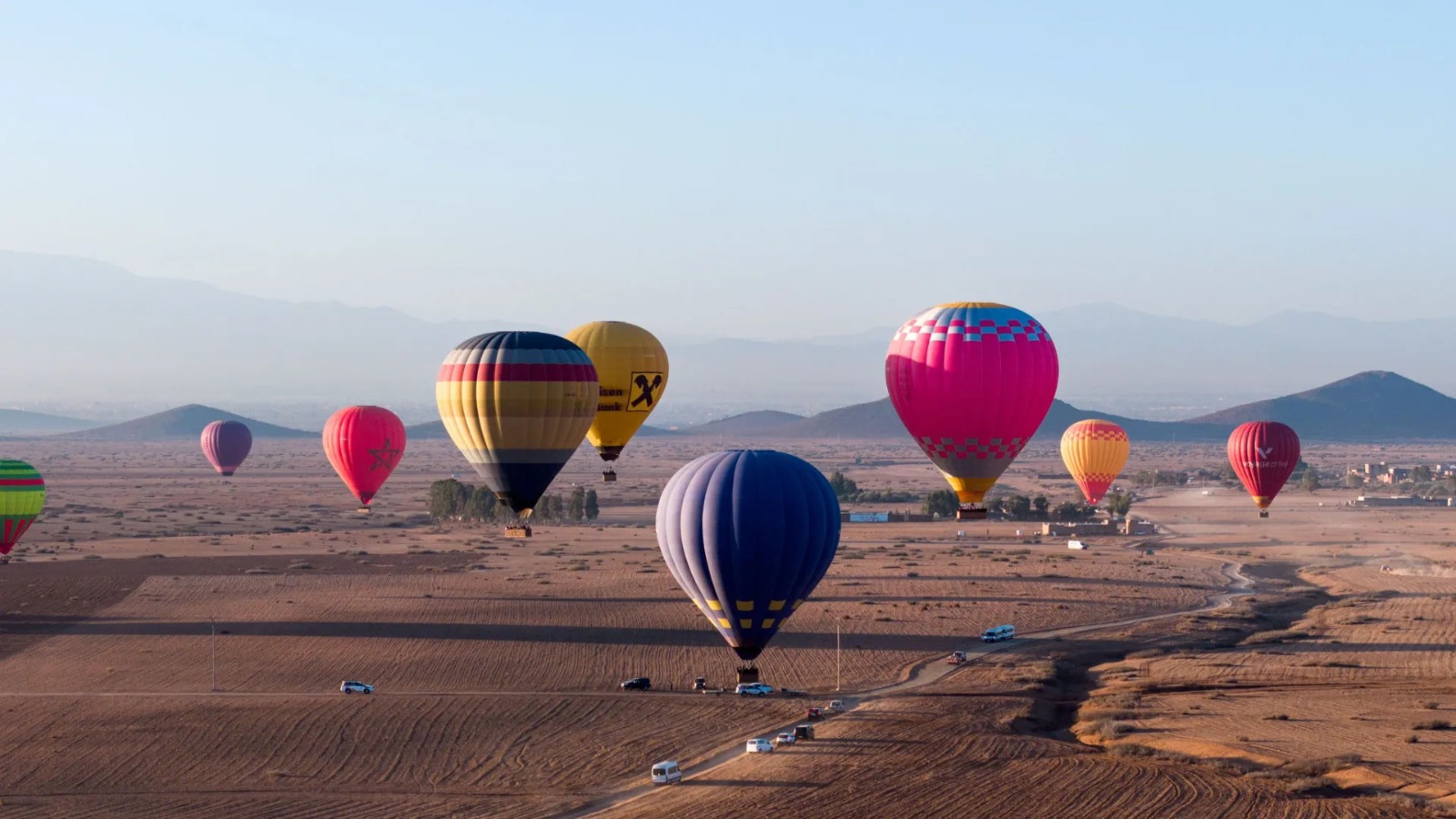
10. Go to the desert for camel rides, quad bike rides, sunrise hot air balloon ride.
More things to do and tourist maps at this link